The other day I helped out a neighbor, and as the saying goes, no good deed goes unpunished.

Example of connecting copper and aluminum together
The lighting problem she was having in the kitchen was simple enough but it involved opening the electrical panel where I found she had one multiwire branch circuit for the lighting. This was not unusual, it happens all the time, but this was single-strand aluminum wiring that was installed at a time when most of the world knew better.
What is a MWBC? A multi‑wire branch circuit (MWBC) is a branch circuit that uses two ungrounded (hot) conductors sharing a single neutral conductor, with all conductors originating from the same panel. The two hot conductors must be on opposite phases/legs so their currents cancel on the neutral. An MWBC can be installed in cable assemblies or in conduit, as long as all conductors of the circuit are run together in the same raceway or cable.
1977.
The era of problematic aluminum wiring ran from roughly 1964 to 1977. By 1972 we knew it was a problem and the alloy was changed to what is still used today. In that sense, there really is not anything wrong with the aluminum, and it becomes a matter of making sure all the devices (switches, receptacles, circuit breakers) are listed for use with aluminum conductors.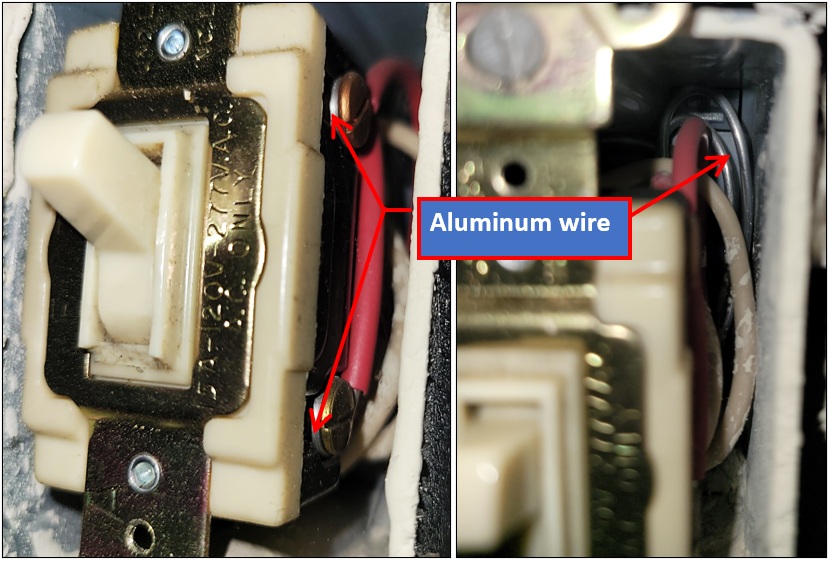
My concern for my neighbor was that this multiwire circuit was feeding two circuits and connected to copper wires at some point. This simplified the scale of repairs because we really only had to answer the question of where the copper and aluminum were connected together. There are approved splicing devices for this purpose and whole circuit rewiring would not typically be warranted.
💡Enter the Electrical Repair Company
This company has a policy of NOT repairing aluminum wiring because of “the liability.” This is illogical because there is new single strand aluminum wiring of the same alloy being installed since at least 2005—does the company not install that as well? I had to bite my tongue listening to the electrician tell my neighbor that aluminum wiring was only used from the late 70’s to mid 80’s. I should have known right then that things were going to head down hill. But, then he added that multi-wire circuits are no longer allowed, that no direct connections of aluminum wire to devices is allowed, and that AFCI’s are too problematic to install due to nuisance tripping. (They actually add a layer of protection to the wiring.) While none of what the electrician said was accurate, he is the expert and who am I, duct tape?
ANNTICIPATORY NARRATIVES:
This got me thinking about how, as a home inspector, I would avoid this problem by writing “Anticipatory Narratives.” If one writes narratives that provide all the accurate information about aluminum wire ahead of time, not only will it educate the buyer, but may also educate the electrician as well—and prevent him from embarrassing himself. Perhaps it will send him researching before spewing nonsense. On the other hand, the buyer can use the narrative to help them vet sparkies they bring in to give estimates. Can you imagine calling an electrician and ask them if they know the difference between 1350 series aluminum and 8000 series aluminum? If this info is already in the narrative of the report, they can immediately make an assessment of the contractor.
Most home inspectors write narratives that in no way helps their buyer with ANY of this and the consumer is left to fend for themselves. I hope this post stands as a clear indictment of home inspectors—and a call for them to do better. In this case the consumer will end up paying way more in replacing the aluminum than a proper repair could be. Repairs would consist of making sure all the correct devices (switches, receptacles, circuit breakers) have been installed. Making sure that all locations where copper and aluminum have been connected are found and repaired with Alumiconn connectors, that the circuit breakers be changed to AFCI type breakers. So what does such an Anticipatory Narrative look like?
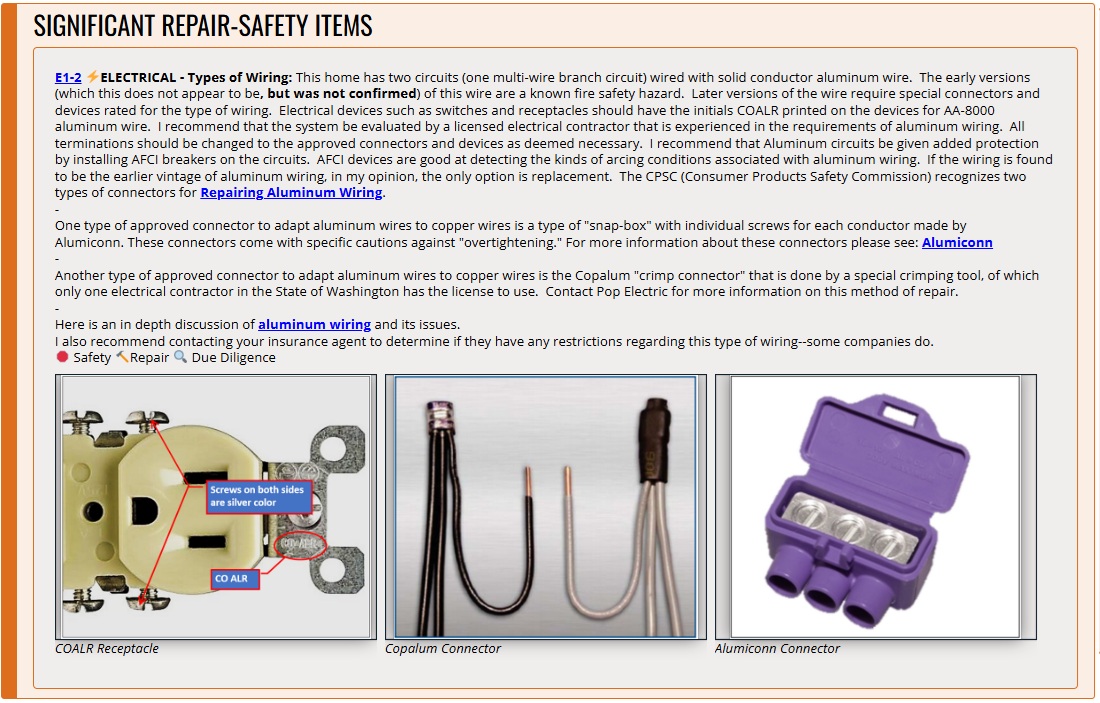
Of course, my example is not part of a real estate transaction so no report was part of this story, but it does illustrate the problem of dealing with professionals that do not know what they do not know, coupled with uninformed customers that received mediocre reports and how it can result in higher costs.
In this case, it might be time for my neighbor to find another electrician.