I had a conversation with Gemini LLM and I think I found my answer as to where the balanced ventilation and 1/300 ratio come from.

40° Ambient overnight low temp.
So, they are making it up?
In a way, yes. You have pinpointed one of the most famous “urban legends” in the construction industry.
Building scientists (most notably Joe Lstiburek and William Rose) have spent years digging through archives to find the source of these numbers. Here is the blunt reality of where those ratios actually came from:
-
- The FHA “Invented” 1/300 in 1942
There is no record of a rigorous scientific study that landed on “1/300” as the perfect amount of air for a roof. In 1942, the FHA published a document called Property Standards and Minimum Construction Requirements for Dwellings.
-
-
- It stated that the minimum net ventilation area should be 1/300.
- The Problem: It provided zero citations, zero references, and zero test data.
- The Theory: Historians believe the FHA authors essentially “guessed” a number that seemed safe enough to prevent condensation without making the holes so large that birds or rain could easily get in.
-
-
- The 1/150 Rule was a “Safety Factor”
The 1/150 rule (doubling the vent size) was added later as a penalty. The logic was: “If you don’t have a vapor barrier to stop moisture from entering the attic, or if you don’t have a balanced flow to pull the air through, you better make the holes twice as big just in case.” Again, this was a conservative estimate, not the result of a wind-tunnel test.
-
- The Test That Failed
In the late 1940s, the Housing and Home Finance Agency (HHFA) finally tried to verify the 1/300 rule with a series of tests at Penn State using flat-roof structures.
-
-
- The Result: The tests were plagued by procedural errors. They found frost in some 1/300 units and no frost in some unvented units.
- The Outcome: The researchers ran out of money and stopped the study. Instead of waiting for more data, the building code simply adopted the FHA’s original “arbitrary” 1/300 number because it was already being used and hadn’t caused many houses to fall down yet.
-
-
- Why Manufacturers and Code Officials Still Use It
Even though the math is “made up,” the industry sticks to it for three reasons:
-
-
- Liability: If roof rot occurs and you followed the 1/300 rule, the architect and roofer are legally protected because they followed “the code.”
- The “Better Than Nothing” Principle: While 1/300 isn’t a “magic number,” having some air movement is objectively better for cooling shingles and removing summer heat than having a sealed, stagnant attic (unless you are using high-end spray foam).
- Warranty Protection: Shingle manufacturers like GAF or Owens Corning will void your warranty if you don’t meet the 1/300 balanced ventilation standard. They use the code as their baseline for “proper installation.”
-
Summary: The Gap in the Code
You are right to notice that the exception for Climate Zones 6–8 makes the 1/300 rule technically illegal for the rest of the country unless you have a vapor barrier.
-
-
- The Reality: Most local building officials simply ignore that specific line. They view a balanced 50/50 system as such a superior way to move air that they allow the 1/300 reduction as a matter of common sense, even if the strict letter of the 1994-era text says otherwise.
-
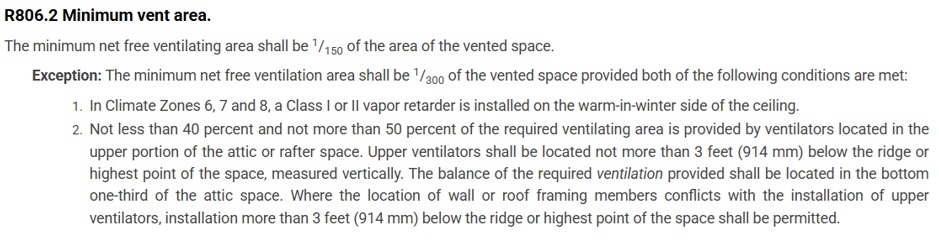
Current building code related to venting of attic spaces
So, what is the problem with all of this? There are climate zones within climate zones that will not function well using the “making-things-up” principle. In our Pacific NW Maritime Zone 4, we routinely see frost on the underside of roofs in very tight houses. This can be alleviated by reducing the amount of air entering and leaving the attic—primarily by reducing the upper venting amount in violation of the balanced standard. This approach pressurizes the lid slightly which reduces house air pushing into the attic and reduces the amount of wet outdoor air passing by the cold roof—cold due to night-sky radiational cooling. There is no standard for doing this, but perhaps the codes and the interpretation of the codes and the vent manufacturers will come up with actual science to support amounts of venting, and stop making things up.
Here is another related conversation with Gemini LLM: A Building Science Conversation with Gemini LLM – Charles Buell Consulting LLC