Water dripping from bathroom exhaust fans is a common occurrence. That this happens even in hot climates and not just cold climates, tells us there is, or can be, more to the story than condensation inside the duct.
Clearly, in climates where exhaust air can reach the dew point condensation can happen. This is especially true if the duct is a long distance to the termination point and/or if the duct is not properly insulated. Even so, with condensation, large volumes of water would not be anticipated, as the velocity of the air is going to carry the bulk of the wet air to the exterior.
Roof leaks is another way water can get into the area around the vent, but this would typically not drip from inside the fan unit.
There is another way that water can get into the duct and run into the fan unit and then into the bathroom. This method involves a certain design of vent cap that, while not intentional, is designed to send water into the exhaust duct. A case of functioning as designed, but not as intended.
This type of termination cap has a raised lip under the vent back-draft damper that functions as dam for any water that gets into the cap. Water should not get into the cap, and the dam is actually there to prevent wind driven rain into the cap. However, water finds another way into the cap along the top of the cap where there is a seal that can fail, and does fail.
My own roof suffered this problem and it took me a couple of years to figure out what was causing the water infiltration. I actually had to remove the cap and test it with water to see what was happening. The following picture illustrates the problem.
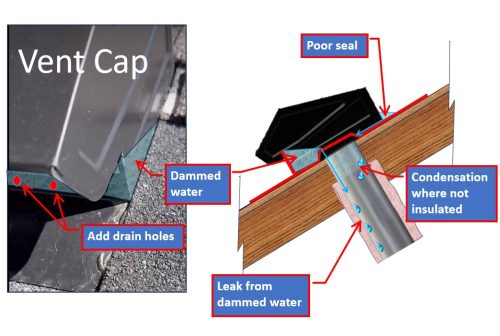
Vent cap poor design
I think that drilling a couple of small holes the bottom of the dam would allow any water that gets into the cap to drain out—or, find a different kind of cap. It is not just one manufacturer that is making vent caps with this issue.
Hope this helps,
Charles Buell