Too much upper ventilation is certainly possible in the Maritime Climate Zone 4 in the Pacific Northwest. This roof is covered with frost due to night sky radiational cooling. The overnight ambient temperature never got below 44°F, yet the roof temperature is clearly below freezing. This is very common in our maritime climate.
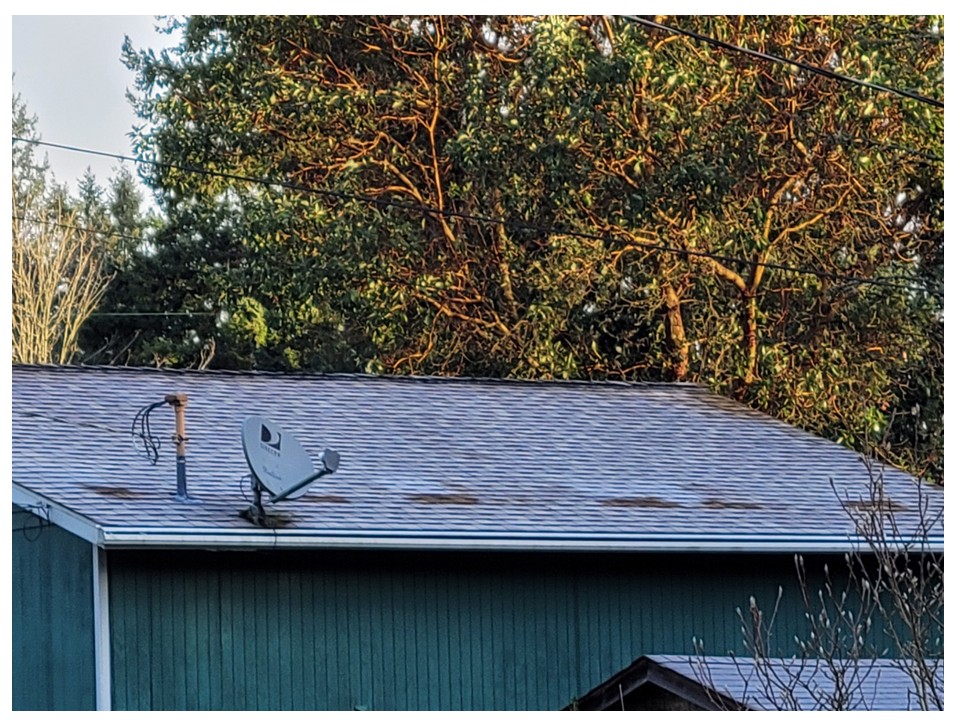
Melted areas show where air moves through the soffit vents into the attic.
The upper ridge vent is between 350 and 500 square inches of net-free-area (manufacturer not determined). There were also gable end vents complicating matters. Maximum soffit intake is approximately 80 square inches of net-free-area (drilled bird blocking but not every bay, two holes per bay.
In the picture of the roof, one can clearly see where the vents are.
At first, the locations almost look like surface in-vents, but it is just where the warmer ambient air streaming through the vents is not allowing the roof surface temperature to drop. The relative humidity at 92%. That means that there is considerable moisture in the air to condense on the underside of the frozen roof. It is very common to see the underside of such roofs covered with frost/mold/dark staining—even when the home is very tight—below 2 ACH-50. The warmer incoming moisture laden air will rapidly reach dew point in the cold attic.
If one is going to make a mistake with venting, it is better to undersize the upper venting than the lower venting. Under-sizing the upper venting slows the total amount of warm moist air entering the attic from the exterior and slightly pressurizes the lid which helps suppress any warm moist air that might be entering the attic from the house interior. This is a common recommendation for homes in Zone 6, but the principles are similar.
Even though there are gable end vents, it is clear that they are either working in conjunction with the ridge vent or are not completely interfering with, or compromising, the soffit intake.
Given that most of the houses we see in the NW are vented with 3-hole bird-blocking, I suspect that most houses are still going to have too much upper venting as ridge vents are the preferred upper venting method.
Charles Buell